If you ask a public-health professional whether Australian tap water is safe to drink, they'll say yes. If you ask a chemist what's in it, you'll get a longer answer. Both are right. This article is the longer answer — without alarmism, without selling you a panic.
The headline: yes, mostly
Every state and territory water authority in Australia tests their supply against the Australian Drinking Water Guidelines (ADWG) — a 1,400-page document maintained by the National Health and Medical Research Council. Compliance is generally above 99% across major utilities. You will not get sick from drinking Sydney, Melbourne, Brisbane, Perth, Adelaide, Hobart or Canberra mains water. That's the truth.
The detail: "safe" includes things you might not love
The ADWG's definition of "safe to drink" allows the following at managed levels:
- Chlorine (0.5–5 mg/L) — added to disinfect the supply between treatment plant and your tap
- Fluoride (0.6–1.1 mg/L in most Australian capitals) — added for dental health
- Chloramine in some networks (e.g. parts of Sydney) — a longer-lived disinfectant
- Trace heavy metals (lead, copper, nickel) — usually from older household pipework, not the supply itself
- Disinfection by-products (trihalomethanes, haloacetic acids) — formed when chlorine reacts with organic matter
- Microplastics — present at low levels, no national limit
- PFAS — at trace levels in some networks (see our PFAS article)
None of these are present at levels that will cause acute harm. Whether you want them in your daily drinking water is a different question.
By city: a quick map
- Sydney: Chloraminated. Hardness moderate. Generally low TDS (~150 ppm).
- Melbourne: Chlorinated. Soft water. Low TDS (~50 ppm) — among the cleanest mains in Australia.
- Brisbane / Gold Coast: Chlorinated. Moderate-to-hard water (see our hard water in QLD article). TDS ~200–300 ppm.
- Perth: Chloraminated. Moderate hardness. Higher chlorine taste in some areas.
- Adelaide: Chlorinated. Notoriously hard water — TDS often 400+ ppm. Many Adelaide households install whole-house systems specifically because of this.
- Cairns / Darwin: Chlorinated. Hot, humid climates can amplify chlorine taste.
- Regional & rural: Quality varies dramatically. Tank water is unfiltered — boiling kills bacteria but doesn't remove chemical contaminants.
When it stops being safe
"Safe" assumes a few things:
- Your home's pipework is in good condition (older homes with copper or galvanised steel may add lead, copper or zinc)
- You're not pregnant or making baby formula (the WHO recommends pre-boiled or filtered water for formula)
- You're not immunocompromised (chlorine doesn't kill all parasites at AWS-mandated levels)
- There hasn't been a boil-water alert (these happen — Sydney 2023, Brisbane 2022, Adelaide 2024)
The "tastes okay if I don't think about it" test
For most healthy adults in major Australian cities, mains water passes the practical test. But: chlorine kills the gut microbiome of beneficial bacteria over time, dries out skin and hair (see our shower-water article), and adds taste/smell that most filtered-water drinkers immediately notice the absence of when they switch back.
Three ways to upgrade
- Under-sink carbon filter ($150–$600 installed) — removes chlorine, taste, sediment, some chemicals. One tap.
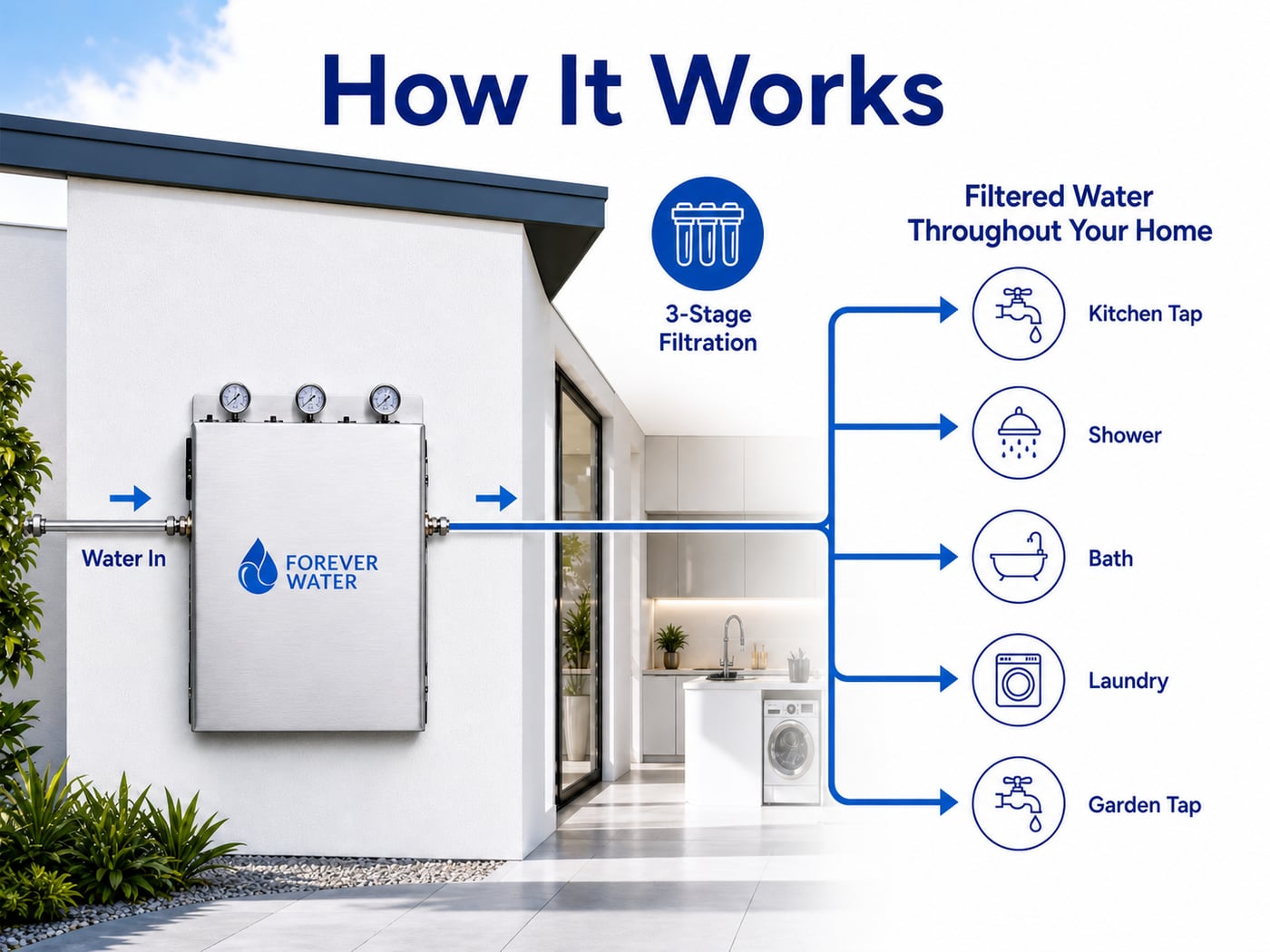
- Whole-house filtration ($3,999 installed) — every tap, shower, bath and appliance protected. Removes chlorine, sediment, chemical contaminants. Best for Australian homes.
- A10 atmospheric water generator ($1,650) — bypasses tap water entirely; pulls water from the air and filters it through 7 stages. Best for ultra-pure drinking water without plumbing.
Read next: Microplastics in bottled water · Whole-house vs. under-sink — which one?