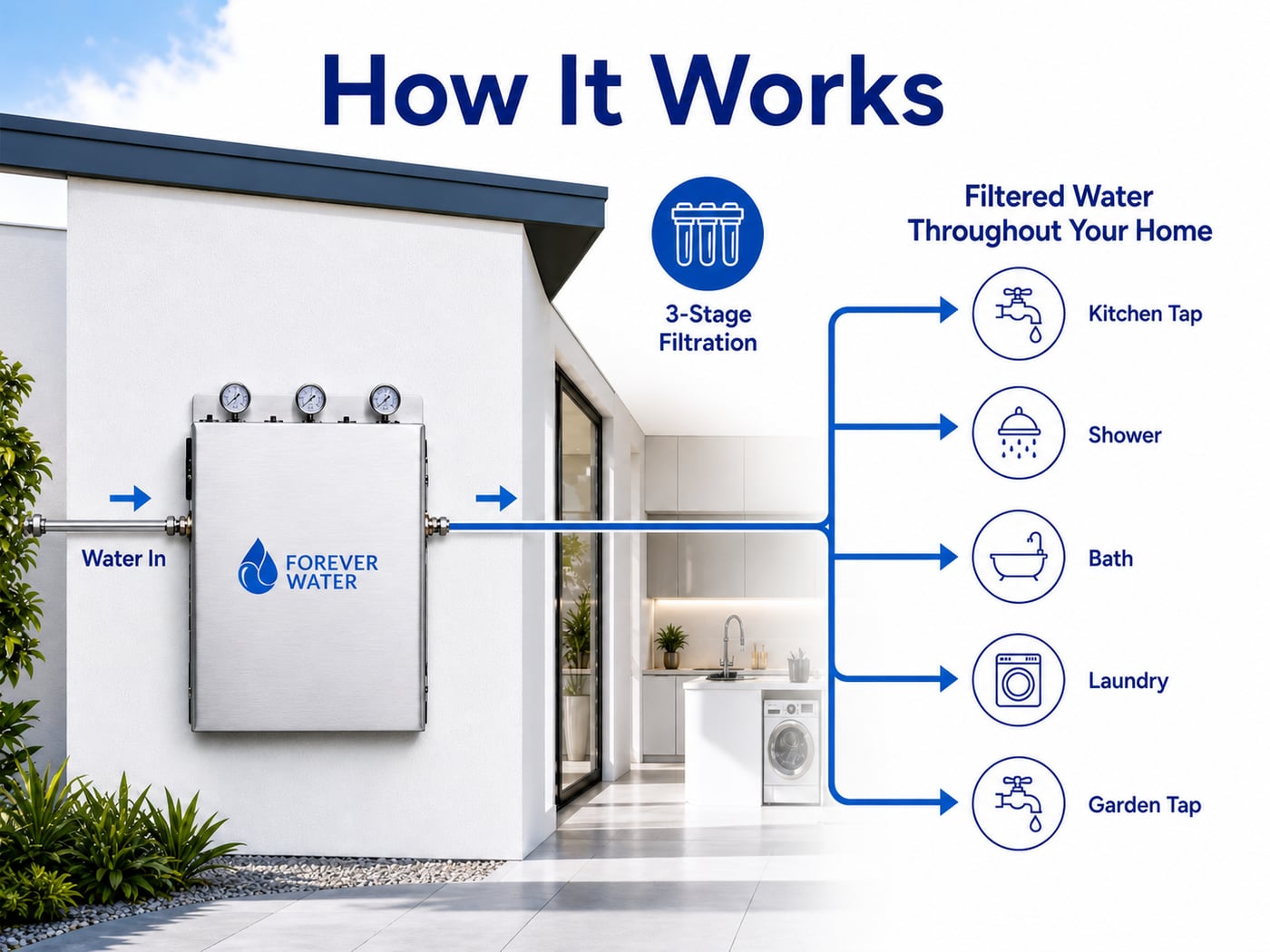
If you've decided you don't love your current tap water, you've got two main paths in Australia: a small filter under one tap, or a bigger filter on the line that supplies the whole house. Both work. They solve completely different problems. This is when each one wins.
The under-sink filter
What it is: a small carbon-block (or carbon + RO) cartridge unit that lives inside the cabinet under your kitchen sink. A second tap (or a diverter on your existing tap) gives you filtered water; everything else in the house stays on unfiltered mains.
Cost: $150–$600 for the unit, +$300–$700 for plumber install if you're not DIY. Filter cartridges $80–$200/year.
Install time: 1–2 hours for a plumber. Self-install is possible but messy.
What it removes: chlorine, sediment, taste/odour, often some chemical contaminants. RO versions also remove fluoride, lead, microplastics and most PFAS species.
What it doesn't: any of your other taps, your shower water, your bath water, your dishwasher, your washing machine, your hot water system, your kettle if you fill it from a different tap, your kids when they brush their teeth at the bathroom sink.
The whole-house filter
What it is: a larger filter unit (typically three 20" × 4.5" cartridges) plumbed onto your home's incoming water line — the supply pipe between the council mains and your house. Every drop of water entering the property passes through it.
Cost: $1,800–$5,500+ depending on stages and capacity. Our HPF-3 system is $3,999 installed. Filter cartridges ~$140/year.
Install time: Half-day for a licensed plumber. WaterMark certification (see our guide) is required for the unit and the install.
What it removes: chlorine, sediment, taste/odour, scale build-up reduction, some chemical contaminants (depending on cartridges). Doesn't typically include RO at whole-house scale (too much waste water for the flow rate).
The straight comparison
| Question | Under-sink | Whole-house |
|---|---|---|
| Filtered drinking water? | ✓ (one tap) | ✓ (every tap) |
| Filtered shower water? | ✗ | ✓ |
| Filtered bath water (kids)? | ✗ | ✓ |
| Protects appliances from scale? | ✗ | ✓ |
| Removes fluoride? | RO models only | Typically not |
| Removes microplastics & PFAS? | RO models: yes | Carbon: 70-90% |
| Upfront cost | $500–$1,300 installed | $1,800–$5,500 installed |
| Annual cartridge cost | $80–$200 | ~$140 |
| 5-year total | ~$1,400 | ~$5,700 |
When to pick under-sink
- You only care about drinking water
- You rent and can't modify the inlet plumbing
- Budget is the deciding factor
- Your tap water is already pretty clean and you mainly want chlorine taste removed
When to pick whole-house
- You have kids who take baths in the unfiltered water
- You or someone in the home has dry skin or eczema that worsens with chlorinated showers (chlorine and shower water article)
- You're in a hard-water area (Adelaide, Brisbane suburbs, much of Queensland)
- You want longer life from your dishwasher, washing machine and hot water system
- You're planning to stay in the house 5+ years
The third option: do both
Plenty of households install a whole-house filter for the home's general supply, then add an A10 atmospheric water generator (or under-sink RO) for ultra-pure drinking water. The whole-house handles bathing, washing, and cooking; the A10 handles the glass on your bench. Many of our customers do exactly this.
Read next: What chlorine in your shower does to skin and hair · Hard water in Queensland: where and why